The H-E-B Effect: How Grocery Stores Can Shape Home Values in Mansfield, Burleson, and Waxahachie
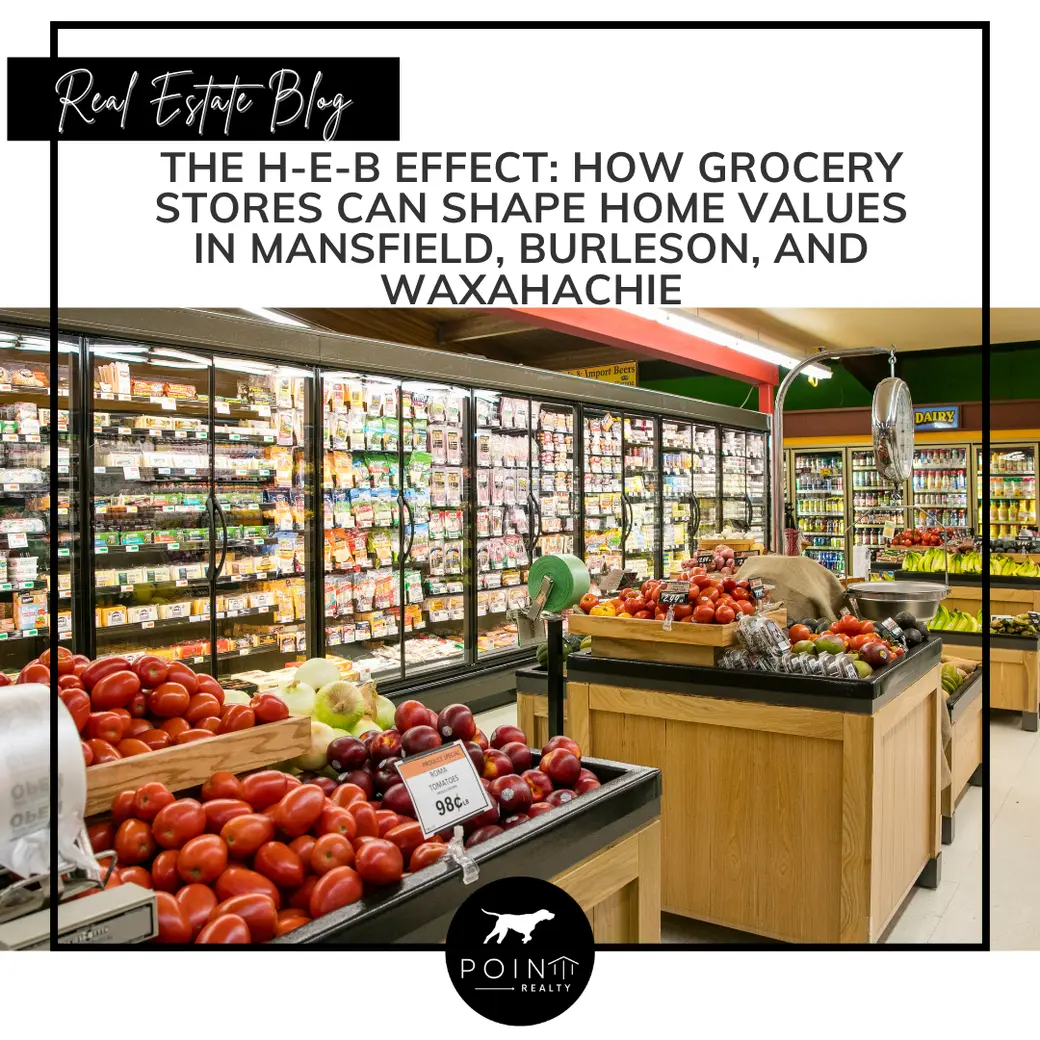
The H-E-B Effect: How Grocery Stores Can Shape Home Values in Mansfield, Burleson, and Waxahachie
If you've spent any time talking about real estate in North Texas, you've probably heard some version of this:
“An H-E-B is coming. Home values are going to go up.”
It sounds simple. And there is some truth behind the idea.
A major grocery store can make a community more convenient, attract additional retailers and restaurants, create jobs and become a signal that a developer sees long-term potential in an area.
But there's more to the story than simply putting an H-E-B on a map and watching home prices rise.
In communities like Mansfield, Texas, Burleson, Texas and Waxahachie, Texas, grocery-store development is an interesting piece of the larger growth story happening across North Texas.
So, what exactly is the “H-E-B effect,” and should buyers and homeowners actually care?
Why Does a Grocery Store Matter to Real Estate?
Think about your typical home search.
You probably look at the school district.
You consider commute times.
You check out the neighborhood.
You think about parks, restaurants and entertainment.
And eventually, someone asks:
“How far is the closest grocery store?”
It's one of those everyday conveniences that doesn't necessarily make a home exciting—but you notice it when it's missing.
That's why a major grocery retailer can matter to a community.
A store such as H-E-B isn't just a place to buy milk and groceries. A large-format store can become an anchor for an entire retail area, bringing traffic that can support restaurants, coffee shops, service businesses and other retailers nearby.
And when those businesses follow, the area can become more convenient and attractive to residents.
That can make a location more appealing to homebuyers.
The Bigger Story Is Often What Comes With the Grocery Store
This is where I think the “H-E-B effect” gets especially interesting.
If you hear that an H-E-B is coming to an area, don't only look at the grocery store itself.
Look around it.
What else is being built?
Are new neighborhoods going in?
Are roads being expanded?
Are restaurants and retail centers being announced?
Are employers moving into the area?
Are schools or other community amenities expanding?
Those things can tell you much more about where a community is headed than the grocery store alone.
In other words, the grocery store may be a symptom of growth rather than the cause of all of it.
A retailer is generally not going to invest millions of dollars in a new location without doing extensive research on the population, demographics, traffic patterns, competition and projected growth.
So when a major grocery chain enters a growing community, it can be a useful piece of information for homeowners and buyers watching that area's development.
What About Mansfield, Texas?
Mansfield is a great example of why local context matters.
The community has experienced substantial residential and commercial growth over the years, and grocery shopping is one part of a much larger retail landscape.
Mansfield residents already have access to multiple major grocery options, including H-E-B, Kroger, Tom Thumb and Walmart, depending on which part of the city they're in.
That means an H-E-B isn't necessarily creating an entirely new grocery market in Mansfield.
Instead, its location can matter more on a neighborhood-by-neighborhood basis.
If a new store opens closer to a growing residential area, it can change the convenience factor for nearby homeowners.
And for someone considering buying a new construction home on the edge of Mansfield, knowing what retail and commercial development is planned nearby can be an important part of evaluating the location.
But I'd still encourage buyers to look at the entire picture.
A grocery store is one amenity. It shouldn't be the reason you buy a house.
Burleson, Texas: Growth and Convenience
Burleson is another community where retail development and residential growth are closely connected.
The city has continued to grow south of Fort Worth, with new neighborhoods, businesses and infrastructure changing the landscape.
And that makes grocery stores particularly interesting.
When a major retailer chooses to locate in or near a growing residential area, it can improve convenience for the people already living there while also making the area more attractive to future residents.
For someone moving to Burleson, Texas, that can be an important consideration.
Maybe you're comparing two neighborhoods that are similar in price, size and school access.
One is a 5-minute drive from a major grocery store and several restaurants.
The other requires a 15-minute drive for most errands.
That difference may not show up dramatically in an online listing description, but you'll feel it every week when you live there.
And those everyday conveniences are part of what buyers consider when deciding where they want to live.
And Then There's Waxahachie, Texas
Waxahachie provides another interesting example.
As the population continues to grow south of the Dallas-Fort Worth area, communities like Waxahachie are seeing more residential and commercial development.
For buyers considering Waxahachie, Texas, grocery stores can be one of several indicators to watch when evaluating a neighborhood's future.
But again, I wouldn't look at a grocery announcement in isolation.
I'd want to know:
-
What residential development is planned nearby?
-
What roads and infrastructure are being improved?
-
What other businesses are coming?
-
How quickly is the surrounding area growing?
-
Are there additional retail centers planned?
-
How far will the store actually be from the home you're considering?
That last question is important.
A grocery store can be “in Waxahachie” without necessarily being convenient to every Waxahachie neighborhood.
Distance matters.
Does an H-E-B Actually Increase Home Values?
Here's where we need to be careful.
It's tempting to say:
New H-E-B = higher home values.
Real estate isn't that simple.
Home values are influenced by dozens of factors, including supply and demand, interest rates, employment, school quality, property taxes, neighborhood condition, new construction, lot sizes, housing inventory and overall market conditions.
A grocery store is only one piece of that puzzle.
Research into retail amenities has found associations between proximity to desirable retail and residential values, but that doesn't mean every grocery store produces the same result or that homeowners should expect a specific percentage increase in value.
And there's an important chicken-and-egg question here:
Did the grocery store increase the home's value—or did the grocery store choose the location because the area was already growing?
Often, it's probably some combination of the two.
A growing population creates demand for retail.
New retail makes the area more convenient.
That convenience can make the community more attractive to buyers.
More buyers can increase housing demand.
And increased demand can contribute to home-price growth.
It's a cycle.
What Homebuyers Should Look At Instead
If you're buying a home and you're excited because an H-E-B is coming nearby, that's great.
But don't stop there.
I would look at the whole development picture.
1. Where exactly is it going?
Five minutes away can be a great convenience.
Half an hour away isn't going to have the same impact on your daily life.
2. What's being built around it?
A grocery store surrounded by restaurants, services and additional retail can create a much more significant lifestyle change than a store sitting by itself.
3. How will you get there?
A store that's technically close but requires crossing a congested intersection every time you need groceries isn't necessarily as convenient as it looks on a map.
4. What does the area look like five years from now?
This is especially important when you're buying in a rapidly developing part of Mansfield, Burleson or Waxahachie.
Look at approved developments, planned roads and surrounding land—not just what's there today.
5. Are you buying the house because you love the house?
This might be the most important question.
Future development is never guaranteed to happen exactly as planned.
So I would never recommend buying a home you don't actually like simply because a favorite retailer is coming nearby.
Buy the home because it works for your life today, while understanding the potential of the area around it.
Sellers Should Pay Attention Too
The H-E-B effect isn't just something buyers should watch.
If you're a homeowner and a major grocery store or retail development is coming nearby, it may become part of the story when you eventually sell.
But again, don't assume:
“There's an H-E-B nearby, so my house is automatically worth more.”
The market determines value.
What the development can do is give buyers another reason to consider your location.
If your home is close to shopping, restaurants, parks, schools and major roads, those conveniences can become part of the overall lifestyle story you're selling.
That's especially useful when you're competing against homes in nearby communities.
A buyer may be comparing two similarly priced homes.
The home that offers the better combination of location, convenience and lifestyle may stand out.
The Grocery Store Is Really a Growth Story
When I hear people talking about the “H-E-B effect,” I think the more interesting question is actually:
“What does this grocery store tell us about the community?”
A major retailer choosing to invest in an area can be an indicator that someone has identified long-term potential there.
And when you combine that investment with new neighborhoods, improved infrastructure, restaurants, schools, parks and employment opportunities, you start to see the bigger picture.
That's what makes watching development so valuable if you're buying or selling real estate.
The map today isn't necessarily the map you'll be living with five or ten years from now.
That's particularly true in fast-growing North Texas communities.
The Bottom Line
An H-E-B doesn't automatically make a house worth more.
But a major grocery store can be an important part of a much larger growth story—and that story is worth paying attention to if you're buying or selling in Mansfield, Texas, Burleson, Texas or Waxahachie, Texas.
When you're evaluating a home, don't just ask, “What's nearby today?”
Ask:
“What's coming?”
“What's changing?”
“And how could this area look a few years from now?”
Those questions can help you make a much more informed real estate decision.
Thinking about buying or selling in Mansfield, Texas, Burleson, Texas, Waxahachie, Texas or another growing North Texas community? Let's talk. I can help you look beyond the house itself and understand what's happening in the neighborhood, what's planned nearby and how those changes may factor into your real estate decision.
Source & Attribution
This article was created as a local North Texas real estate and lifestyle analysis based on publicly available information about grocery-store development, retail growth and residential markets. Individual development plans, store openings and construction timelines can change, so buyers and sellers should verify current plans with the applicable city and retailer before making decisions based on future development.
Categories
- All Blogs 450
- Arlington, TX 6
- best deal 1
- broad street 1
- brokerage 1
- build your home 40
- builders 21
- building a business 2
- burleson 5
- buyers market 129
- buying a home 262
- closing costs 41
- Community 12
- community spotlight 1
- condominiums 12
- credit 9
- Dallas 2
- dallas property tax 1
- dallas real estate 59
- DFW Lifestyle 17
- dfw property tax 1
- down payment 43
- down payment assistance 3
- downsizing 29
- finances 37
- first time home buyer 137
- for sale by owner 16
- Fort Worth 5
- Fort Worth real estate 58
- home affordability 124
- home equity 41
- home insurance 6
- home loan 89
- home ownership 159
- home price 110
- home tips 69
- home value 107
- housing market 196
- interest rates 70
- investment 32
- leasing 2
- listing agent 13
- Living in DFW 12
- Living In Texas 7
- local events 5
- lower interest rate 6
- luxury homes 4
- Mansfield real estate 57
- Mansfield, TX 9
- Midcities 5
- Midlothian, TX 6
- money savings 1
- mortgage 77
- mortgage rates 64
- moving to Texas 16
- neighborhood news 4
- new construction 28
- new developments 1
- new home 58
- owning a home 61
- preapproval 29
- pricing your home 71
- property management 7
- property taxes 1
- real estate 210
- real estate agents 5
- real estate taxes 3
- real estate tips 188
- realtors 4
- relocating 8
- relocating to Texas 20
- rental 3
- renting 8
- restaurants 1
- savings 14
- school districts 2
- second home 30
- sellers 130
- selling and buying a house at the same time 5
- selling your home 140
- senior living 16
- state income tax 1
- texas property tax 1
- texas taxes 1
- things to do 1
- vacation home 7
- Veterans 3
- wealth 14
Recent Posts





GET MORE INFORMATION